Baseball.com.au Baseball.com.au
News
Hub: 2026 World Baseball Classic
Play Baseball
Find a ClubBaseball5™Sporting SchoolsMobile Coach AppCoachesUmpiresScorersCome and Try Days / EventsAussies Abroad
Events
Hub: 2026 U18 and U16 NationalsHub: U18 World CupEventsEvents CalendarAustralia at World Series 2025National ChampionshipsLittle League
Media
WatchPro Aussies AbroadPodcastCommunityDocumentaryJoin the Mailing List
Governing the Game
Baseball Australia WebsiteAbout Us and BoardStrategic PlanResourcesBaseball Information HubNational Integrity PlanCorporate ReachBaseball CalendarContact Us
Australian National Teams
Team Australia
Team Australia Event Archive
National Tournament Archive
...
Governing the GameAustralian National TeamsTeam Australia Event ArchiveNational Tournament Archive
En
Select a Language
  • News
  • Hub: 2026 World Baseball Classic
  • Play Baseball
    Back
    • Find a Club
    • Baseball5™
    • Sporting Schools
    • Mobile Coach App
    • Coaches
    • Umpires
    • Scorers
    • Come and Try Days / Events
    • Aussies Abroad
  • Events
    Back
    • Hub: 2026 U18 and U16 Nationals
    • Hub: U18 World Cup
    • Events
    • Events Calendar
    • Australia at World Series 2025
    • National Championships
    • Little League
  • Media
    Back
    • Watch
    • Pro Aussies Abroad
    • Podcast
    • Community
    • Documentary
    • Join the Mailing List
  • Governing the Game
    Back
    • Baseball Australia Website
    • About Us and Board
    • Strategic Plan
    • Resources
    • Baseball Information Hub
    • National Integrity Plan
    • Corporate Reach
    • Baseball Calendar
    • Contact Us
  • Australian National Teams
    Back
    • Team Australia
  • Team Australia Event Archive
  • National Tournament Archive

News

Select
  • All Categories
  • - Aussies Abroad
  • - Little League
  • - Team Australia
  • ABL
  • APBC
  • Aussies Sign Pro
  • Australian Youth Championships
  • Baseball5
  • College Baseball
  • Community
  • No elements found. Consider changing the search query.
  • List is empty.

25 August 2024 By Staff Writers

By Staff Writers

History: Olympics

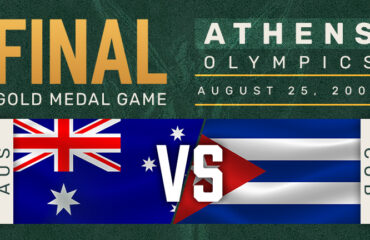
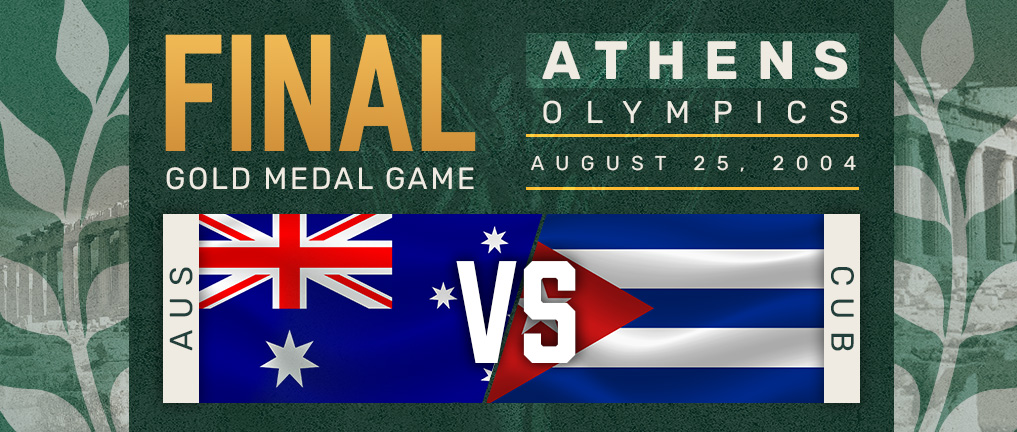
2004 Olympic Baseball: Australia wins Olympic silver after Cuba wins dramatic Gold Medal match

by Robert Laidlaw |  Greece, August 25, 2004 – 

This story is part of a series running on baseball.com.au from August 15-25 commemorating the 20-year anniversary of the 2004 Australian Olympic Baseball team. Each day will feature a recap and story as if the tournament is happening now. Scroll to bottom of this story for more links and recaps.

PROUD AUSTRALIA WINS SILVER
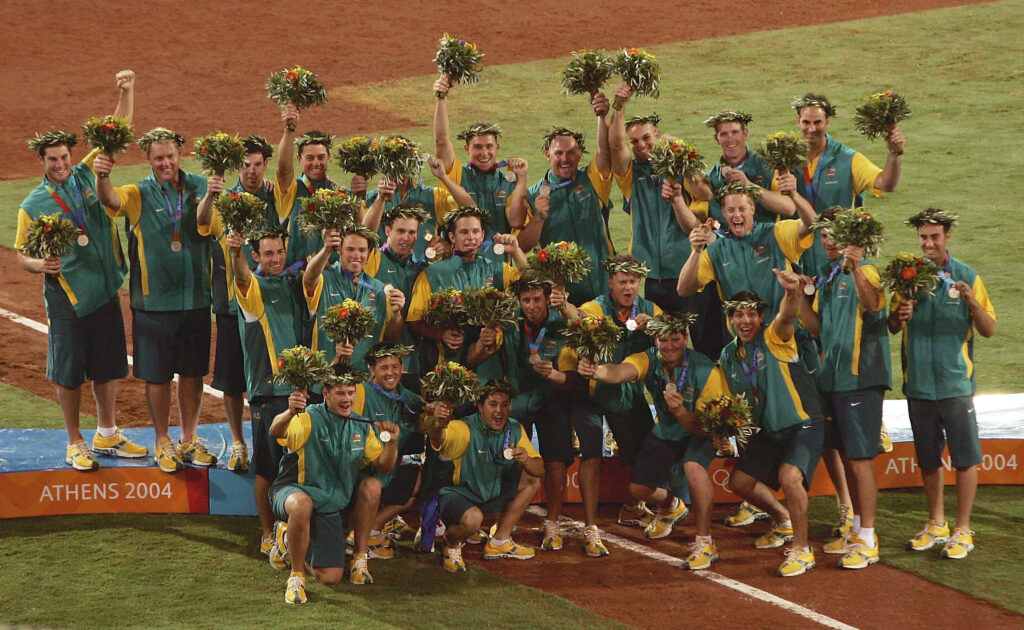
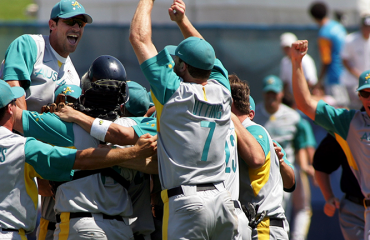
ATHENS – AUGUST 25: Silver medal winning team of Australia pose for a picture after receiving their medals during the medal ceremony for baseball on August 25, 2004 during the Athens 2004 Summer Olympic Games at the Baseball Centre in the Helliniko Olympic Complex in Athens, Greece. (Photo by Nick Laham/Getty Images)


Although Australia lost the gold medal game 6-2 in the 2004 Olympic baseball tournament in Greece, a silver medal was still a worthy prize for all the hard work.

But the gold medal could have been the Aussies with a bit of luck, as several controversial decisions went against them in the game.

The first was in the bottom of the fourth with Australia trailing 2-0. Australia had two runners on-base and two out when Tom Brice smashed the ball over the centrefielder’s head.

Brice had a three ball, one strike count on him when he unloaded with the big hit, which seemed to hit the home run fence as Cuban centrefielder Carlos Tabares juggled the catch. Replays would suggest otherwise.

WATCH THE REPLAY: 2004 Olympic Gold Medal Game

Tabares held the glove up in the air triumphantly and the umpire signalled an out, which retired the side.

Australian manager Jon Deeble argued the call long and hard, which caused his ejection.

The second major controversy came at the top of the sixth, when Cuba had two runners on and no outs, when catcher Ariel Pestano appeared to have upset the home plate umpire and was thrown out of the game.

After a long delay and arguments from the Cubans, Pestano was allowed to continue his at bat, which visibly upset the Australians, as they then proceeded to concede four runs and fell 6-1 behind.

BOX SCORE AND PLAY-BY-PLAY: Click here for detailed stats and box score

Starting pitchers John Stephens for Australia and Cuban Norge Vera were in control early, with neither side able to score through the first three innings.

At the top of the fourth, Osmani Urrutia ran out an infield single and Frederich Cepeda smashed a long home run – 2-0 Cuba.

Then the bottom of the fourth, where it seemed the Aussies were back in it but for the third out call made against Brice.

David Nilsson had walked and, with two out, Andrew Utting singled. But both were left stranded after that controversial call on Brice’s hit.

In the bottom of the fifth, Paul Gonzalez led of with a home run – what could have been? Australia was back in the game, just one run behind at 2-1.

But then the top of the sixth happened, which in the end was the deciding rally that won Cuba the gold medal.

Urrutia and Cepeda both collected singles, before Pestano’s at bat, which, after he was reinstated, collected a single up the middle to load the bases. Eriel Sanchez then collected a two-run hit, and it saw Stephens relieved on the mound by Ryan Rowland-Smith.

After Danny Miranda put two runners in scoring position with his sacrifice bunt, and with two out, Eduardo Paret hit a two-run double and it was 6-1 Cuba.

There was only one more run scored in the game, when in the bottom of the eighth, Utting and Brice collected two out walks, and Brett Tamburrino had a RBI single, for Australia’s second run.

Cuban reliever Adiel Palma pitched 3.2 innings for the win, conceding four hits and three walks for five strikeouts. Aussie starter Stephens took the loss, giving up 10 hits and no walks in five frames, for three K2s.

“The feeling afterwards was weird,” said Aussie outfielder Tom Brice. “There was the excitement of the day before, beating Japan. Going in, if we lost we still get a silver medal. It’s strange, you go out to win but the result is still better than expected going into the Olympics.”
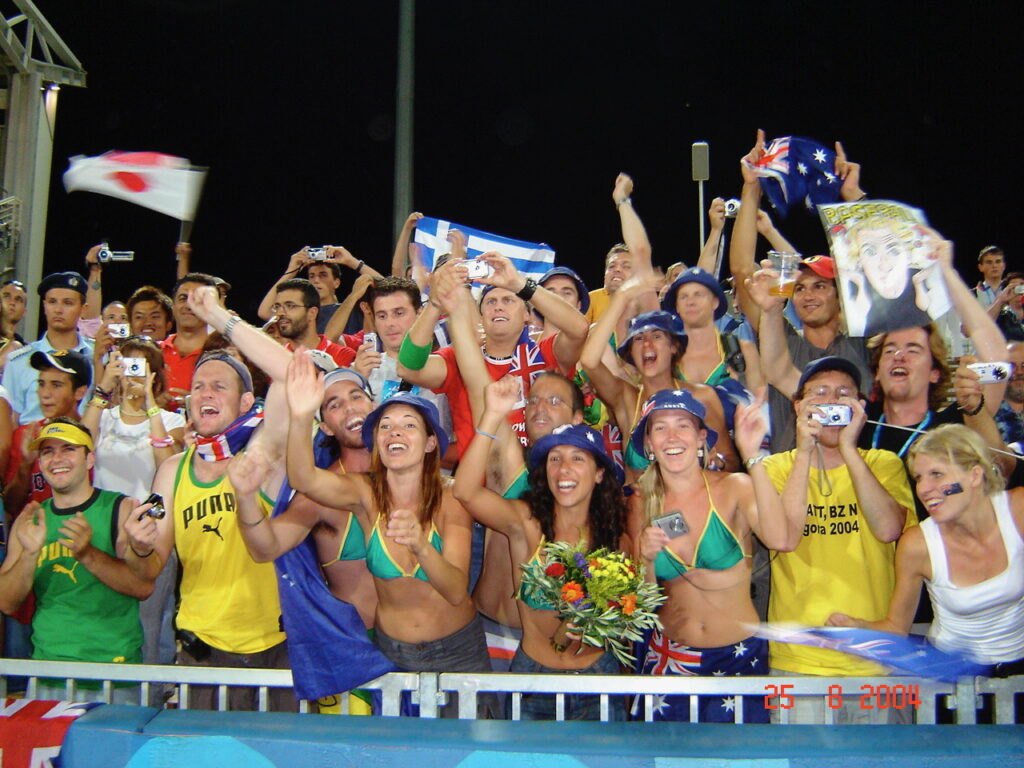
The silver medal still tastes sweet.

“We didn’t win but came away with something amazing. I don’t think there are any other cases like that, you’re not the champion team but an Olympic silver medal will follow me forever,” he says.

For David Nilsson it was one of the toughest moments as a competitor he had experienced.

On balance, Nilsson had a wonderful MLB career, was the first Aussie to make the All-Star game (1999), and had been the MVP of Australia’s thrilling gold medal win against Cuba in the 1999 Intercontinental Cup, as well as playing in the 2000 Olympics.

But always striving for his best, Nilsson was disappointed in not winning an Olympic gold medal.

“In the locker room after game I did not feel we won silver, I felt we lost an opportunity for gold and was really shattered,” Nilsson said.

“But at the same time, we were silver medallist at the Olympics, so 15 minutes afterwards, I kept it (disappointment) to myself, as I did not want to spoil the moment. I was just frustrated about some of the things that happened,” he adds. “Then when we went out to the medal ceremony, and standing with the team, with silver around my neck, it was a wonderful moment. But, while it was one of the best moments in sport, it was still one of the most frustrating and disappointing.”
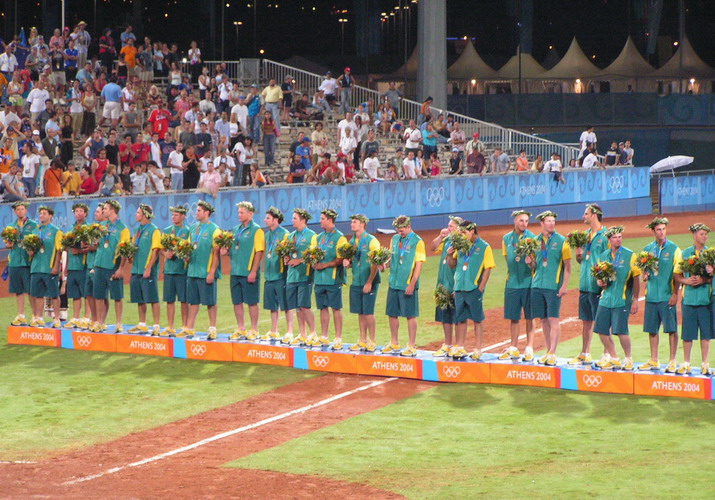
ON THE TOM BRICE HIT TURNED CATCH…

That ‘fly’ ball by Brice in the bottom of the fourth inning was a huge turning point in the game, as it could have set up a different outcome.

“My approach with a three balls and one strike count was to sit on a good pitch I could drive, and I was ready,” Brice said. “Sure enough, it was a fast ball down the middle, a bit of a cookie. The ball wasn’t carrying that day and initially I did not feel I hit it as far as I did.”

It carried far and camera angles seem to show a clear hit.

“There was some back spin on the ball, so it travelled further. As I ran down the line, I saw the outfielder run into fence, but did not see the ball, so thought it went over, until I saw the centrefielder with his glove in the air and massive smile on his face.”

“I was none the wiser, and thought he made an amazing play. It went from thinking I had hit a three-run homer, to us being out of the innings. But when I returned to the dugout the chatter was that the ball had popped out and hit the fence before it was caught, so it should have been a hit.”

“(Jon) Deeble was insistent in arguing the point longer than he would normally, and as it turned out, he was 100 percent right.”

“After the fact, it’s one of those things, the ump called me out, it is what it is, move on. Obviously annoying but sport sometimes goes your way, sometimes not.”

“It was the biggest game I played in. That’s sport, that’s life, it cannot be changed, so no point in dwelling on it.”

Here’s what Dave Nilsson had to say…

“As for Tom’s (Brice) hit, we thought we saw it clearly hit the fence from the dugout, but maybe it didn’t? It looked clear from where we were. The stuff that happens, with officiating, things that happen. I bit my lip at the interview after the game.”

“And when one of their main hitters was thrown out for arguing, I was right there. It was shocking (to see him back in the game).”

And Jon Deeble…

Jon Deeble knew in his heart the Tom Brice ball had hit the fence and wasn’t going to just let sleeping dogs lie, and argued hard for his team but to no avail, earning an ejection.

Although it’s never nice to be thrown out of a big game, Deeble stood up for his charges and fought tooth and nail for what he believed in, which is part of the reason Australia did so well in the Olympic campaign.

“My take, I thought it hit the fence,” Deeble said. “As a ran out of the dugout on the third base side, a cameraman told be it clearly hit the fence and wasn’t a catch, so I was confident in arguing our point.”

“But the umpires that day did not speak much English, which was frustrating. I went to the chief umpire and told him that ‘you guys need to get together’ but he refused to do it. It was so disappointing, and a kick in the guts.”

“Playing Cuba, when they get behind they start arguing, so I thought we could have won that gold medal, if that call had gone our way.”

“As for winning a silver medal, it’s something we should celebrate, as it’s still a magnificent achievement.”

Paul Gonzalez on his Gold Medal game homer

Instead of being Australia’s first run of the gold medal game with his homer in the fifth inning, Paul Gonzalez could have been the go-ahead run and the game situation could have been changed in Australia’s favour.

“While my home run kept us in it, who knows what would have happened if Tom Brice’s hit had been ruled fair,” Gonzalez said.

“Cuba plays with emotional momentum, and we had almost knocked them out of their mental state – they use so much emotion.

“If Tom’s hit had been called safe, the game would have seen us ahead, rather than 2-0 behind – it was a complete game changer. We had the arms to keep us in the ballgame if we were ahead.”

Other stories:
– Semi Final Recap: Australia vs Japan
– Game 7 Recap: Australia vs Canada
– Game 6 Recap: Australia vs Netherlands
– Game 5 Recap: Australia vs Greece
– Game 4 Recap: Australia vs Japan
– Game 3 Recap: Australia vs Italy
–
Game 2 Recap: Australia vs Chinese Taipei
– Game 1 Recap: Australia vs Cuba
– Preview: Australia looks to learn from success and failures past ahead of 2004 Olympics
– Roster: Meet the 2004 Australian Olympic Baseball team


Tag Cloud:
2004 Olympics

18 August 2024 By Staff Writers

By Staff Writers

History: Olympics

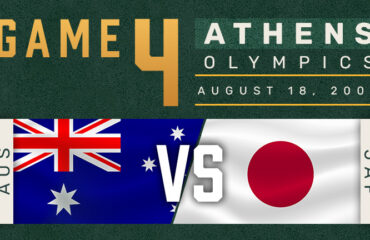
2004 Olympic Baseball: Australia stuns Japan in Olympic baseball group stage upset

by Robert Laidlaw |  Greece, August 18, 2004 – 

This story is part of a series running on baseball.com.au from August 15-25 commemorating the 20-year anniversary of the 2004 Australian Olympic Baseball team. Each day will feature a recap and story as if the tournament is happening now. Scroll to bottom of this story for more links and recaps.

COMEBACK AUSSIES IN THE HUNT

Australia has sent a clear message to the baseball world: we are medal contenders at the 2004 Olympics.

The Aussies shocked previously undefeated Japan with a 9-4 comeback win to even their record at 2-2 and breathe serious life into their Olympic campaign.

It’s a big bounce back from an 0-2 start to the tournament.

Tag Cloud:
2004 Olympics

18 August 2024 By Staff Writers

By Staff Writers

History: Olympics

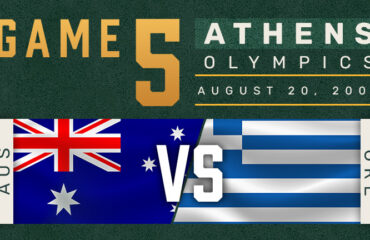
2004 Olympic Baseball: Australia storms back from five runs down to beat Greece

by Robert Laidlaw |  Greece, August 20, 2004 – 

This story is part of a series running on baseball.com.au from August 15-25 commemorating the 20-year anniversary of the 2004 Australian Olympic Baseball team. Each day will feature a recap and story as if the tournament is happening now. Scroll to bottom of this story for more links and recaps.

Call it a comeback.

Australia stormed back from a five run deficit to defeat Greece 11-7 and gain a winning record after game five of the 2004 Olympic baseball tournament in Athens.

A five-run seventh inning for the Aussies broke open a close one-run game that at one stage looked to be owned by the Greeks.

Greece opened up an early 5-0 lead and even led 6-3 in the sixth inning before the Aussies fought back.

BOX SCORE AND PLAY-BY-PLAY: Click here for detailed stats and box score

Greece came out with all guns blazing to score four runs at the top of the first inning, after hits to Peter Maestrales, James Demetral, Cory Harris, James Kavourias and future MLBer Nick Markakis.

Then at the top of the second, Maestrales smashed a home run and Greece seemed to be in full control, as Australia failed to collect a hit off Greek starter Clinton Zavaras in the first two frames.

Finally, some noise from the Aussie bats in the bottom of the third.

Craig Lewis led off with a single, followed by Paul Gonzalez’s huge home run. Later, Brett Roneberg also put one out, and it was 5-3 Greece. There was life.

The next two innings were scoreless, as Greece continued to hold on, and then at the top of the sixth gained a bit of breathing space, after back-to-back doubles to Kavourias and Peter Rasmusen, to go 6-3 up.

But Australia responded in the bottom of the sixth close the gap.

Roneberg hit his second dinger of the game, followed by David Nilsson walking and coming home on Glenn Williams’ double.

Australia trailed 6-5 in the bottom of the seventh and needed to find a way to grab the lead for the first time in the game.

Brett Tamburrino led off with a walk and went to second base on Rodney van Buizen’s bunt. Gavin Fingleson did the job with a single to tie the scores.

Fingleson stole second base, Nilsson reached on an infield hit, Williams hit a RBI double for the lead, and then the big blow, as Brendan Kingman cleared the bases with a three-run homer.

Although leading 10-6, no game is safe, especially when Kavourias led off the top of the eighth for Greece with a home run, but that was it for the home country.

Australia added another run in the bottom of the eighth on Fingleson’s RBI single.

“For our medal chances the Greece game was a must win,” said slugger Paul Gonzalez. “After a couple of early losses, every game was critical, and anytime you’re playing the host nation you need to be wary – they were a tough side, with US born Greeks.”

Gonzalez’s homer seemed to spark the Australian bats in this game.

(PHOTO: OMAR TORRES/AFP via Getty Images)

“We needed to position ourself for later on (in the tournament) and gain some momentum, which we did by overcoming an early deficit. For me personally, you’re always happy to ignite the offence, so yes, it was good to hit that home run to help us get started.”

Gonzalez said preparation was key for the Australian bats.

It was another team effort. Roneberg, Williams and Fingleson each had two hits while eight different players in the line-up reached base.

“We had faced him (Greek pitcher Zavaras) in a few exhibition games, I knew he threw a lot of changeups, I sat on one and drove it over the rightfield fence – he couldn’t beat me with the fastball, as I would go after it if he left something up,” said Gonzalez. “Anything I could contribute, that’s always the goal. Everyone knew they had a role – one hit, one pitch, they knew their role.”

Gonzales has the rare distinction of playing in Australia’s previous senior medal winning tournaments, in Intercontinental Cups – bronze in 1997 and gold in 1999.

Although having retired after the 2000 Olympics, Gonzalesz returned to support David Nilsson and manager Jon Deeble to help add some experience for the 2004 Olympic campaign.

Australia now sits at 3-2 in the tournament and moves into a Top 4 spot. If they can find a way to beat Netherlands tomorrow, it likely clinches a spot in the medal rounds.

Here are other scores from Day 5 of the Olympic Baseball tournament:
– Italy 5 def Chinese Taipei 4
– Japan 9 def Canada 1
– Cuba 9 def Netherlands 2

Standings After Day 5
1. Japan 4-1
2. Cuba 4-1
3. Canada 4-1
4. Australia 3-2
—-
5. Netherlands 2-3
6. Chinese Taipei 2-3
7. Italy 1-4
8. Greece 0-5

Other stories:
–
Game 4 Recap: Australia vs Japan
– Game 3 Recap: Australia vs Italy
–
Game 2 Recap: Australia vs Chinese Taipei
– Game 1 Recap: Australia vs Cuba
– Preview: Australia looks to learn from success and failures past ahead of 2004 Olympics
– Roster: Meet the 2004 Australian Olympic Baseball team

Tag Cloud:
2004 Olympics

17 August 2024 By Staff Writers

By Staff Writers

History: Olympics

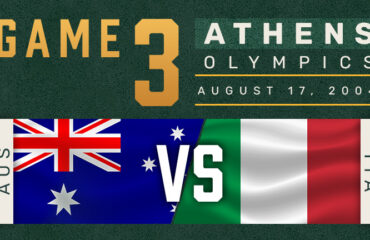
2004 Olympic Baseball: Tournament back on track as Australia picks up first win over Italy

by Robert Laidlaw |  Greece, August 17, 2004 – 

This story is part of a series running on baseball.com.au from August 15-25 commemorating the 20-year anniversary of the 2004 Australian Olympic Baseball team. Each day will feature a recap and story as if the tournament is happening now. Scroll to bottom of this story for more links and recaps.

BASEBALL CAMPAIGN KICK STARTED

Finally, some breathing space, as Australia won its first game at the 2004 Olympic baseball tournament in Greece, with a 6-0 victory over Italy.

Starting pitcher Chris Oxspring was brilliant on the mound to give Australia a fighting chance.

The game wasn’t as easy or as distant as the scoreline depicts.

The game was scoreless through the first six innings, although Australia picked up a hit in each of the first five frames.

The key to the Aussies’ win was the pitching of Chris Oxspring. He threw a one-hitter for eight innings, with one walk and five strikeouts. Ryan Rowland-Smith pitched a scoreless ninth to keep the shutout in order.

That’s magic from two eventual Australian Major Leaguers.

(PHOTO: Chris Oxspring was dominant in the win. Photo by Clive Mason/Getty Images)

It took an error and a hit batsman to set up Australia’s first runs in the top of the seventh. Andrew Utting reached on a misplay, Gavin Fingleson was hit-by-a-pitch, and Brett Roneberg smashed a two-run double – 2-0 the Aussies.

It seemed just a matter of time before Australia would bunch its hits to score, and it did at the top of the seventh, with Tom Brice, Utting, Fingleson, Rodney van Buizen and David Nilsson collecting singles, for four runs, to pad out the margin to 6-0.

Through the first five innings Oxspring was perfect, facing 15 Italians for 15 outs, with just Giuseppe Mazzanti spoiling the party with a leadoff single in the bottom of the sixth, for his country’s sole hit of the game.

BOX SCORE AND PLAY-BY-PLAY: Click here for detailed stats and box score

From the mound for Italy, Michael Marchesano was plucky, holding the Aussies at bay, before being relieved with two out in the seventh frame, conceding six hits for three walks and four K2s in 6.2 innings.

“In such a short tournament we had nothing to lose after going into the Italian game 0-2,” said Tom Brice, who went 3-for-5 in the game.  “Well, it was difficult to go anywhere, as we still had to play Japan, so it was a matter of taking every game as it comes, and at this stage it didn’t look like we would make the medal rounds.”

Brice’s three hits were crucial in Australia’s win. He was an omission from the starting line-up the first two games.

“On a personal perspective, I was annoyed I didn’t start the first two games, so I went into this game with a bit of a chip on my shoulder and wanted to prove a point. I felt I deserved to be in line-up, so, it was pleasing to get three hits.”

“With a team like Italy, as long as you stay in touch, and (Chris) Oxspring was throwing a hell of a game, you know they don’t have the depth.”

Brice said it was a challenge to get by the plucky Italian pitching.

“Their starter was one of their more experienced and better players, so we knew once we got through him, they did not have the depth to hold us off. It was just a matter of trying to chew up pitches, with longer at bats.”

With his strong showing in this game, Brice has set up his tournament and with his outstanding play in the outfield, he is a monty to remain in the starting nine for the rest of the tournament.

As for Oxspring, his outing has helped put Australia back on track, and has put his name at the top of the list as a candidate to pitch in the medal rounds, if the Aussies can continue to play well.

“Going into the game (against Italy), you know, I always felt confident,” Oxspring said. “You still had to consider the unknown, with the players Italy sourced from America. Who were the dangers? But we had good scouting reports on who we could attack and who to avoid in big situations.”

“We had a good game plan and we executed it well, and came away with the win.”

Oxspring said the moment was not lost on him.

“For me it was the first game I played as an Olympian. The whole situation was emphasised, magnified, as far as the importance of beating Italy,” he said.

“That win was a way to bring the team forward, so we could turn our tournament around and move on.”

Australia improves to 1-2 on the tournament but have a date with undefeated Japan looming tomorrow. Australia likely needs a victory to keep their chances of progressing alive.

Here are other scores from Day 3:
– Canada  7 def Netherlands 3
– Chinese Taipei def Greece 1
– Japan 6 def Cuba 3

Standings After Day 3
1. Japan 3-0
2. Canada 3-0
3. Cuba 2-1
4. Chinese Taipei 2-1
—
5. Australia 1-2
6. Netherlands 1-2
7. Greece 0-3
8. Italy 0-3

Top four advance to semi finals.

Other stories:
–
Game 2 Recap: Australia vs Chinese Taipei
– Game 1 Recap: Australia vs Cuba
– Preview: Australia looks to learn from success and failures past ahead of 2004 Olympics
– Roster: Meet the 2004 Australian Olympic Baseball team

Tag Cloud:
2004 Olympics

16 August 2024 By Staff Writers

By Staff Writers

History: Olympics

2004 Olympic Baseball: Australia in early hole after dropping second Olympic game to Chinese Taipei

by Robert Laidlaw | 2004 OLYMPIC BASEBALL – Greece, August 16, 2004 – 

This story is part of a series running on baseball.com.au from August 15-25 commemorating the 20-year anniversary of the 2004 Australian Olympic Baseball team. Each day will feature a recap and story as if the tournament is happening now. Scroll to bottom of this story for more links and recaps.

IS IT OVER BEFOR IT GETS STARTED?

After dropping its first game to Cuba, Australia has dug themselves in huge hole after a 3-0 loss Chinese Taipei in game two of the 2004 Olympic baseball tournament in Greece.

It was always going to be a tough battle. Chinese Taipei also entered the game with an 0-1 record and send highly touted pitcher Chien-Ming Wang to the mound. Wang would progress to a nine year MLB career, mainly with the Yankees, right after the Olympics.

But back to the ball game…

Both starting pitchers, Australia’s John Stephens and Taiwan’s Wang, were solid and each lasted seven innings. Chinese Taipei scored twice in the third inning and once in the eighth.

At the top of the third with one out, Yung-Chi Chen and Chih-Yuan Chen collected singles, with the first run coming in on Chung-Yi Huang’s grounder, which was errored. The second run came from a RBI hit to Cheng-Min Peng.

Then at the top of the eighth, Peng hit a RBI double, which forced a pitching change. In Australia’s last two frames, hits to Gavin Fingleson (eighth) and David Nilsson (ninth), were not capitalised on.


BOX SCORE AND PLAY-BY-PLAY: Click here for detailed stats and box score

Stephens pitched 7.1 innings for seven hits and a walk for two strikeouts in taking the loss. Wang conceded just three hits in seven shutout frames to claim the win for Chinese Taipei.

“It was pretty straight forward, we never wavered but faced good pitching,” Nilsson said. “Straight after the game we addressed what had happened. We were a good team, and don’t need to change much. Trust the process – we are good enough.”

Nilsson added the mentality of the Australian team was to trust their preparation.

“We were prepared, so the message was simple, don’t worry about 0-2, just take it one game at a time.”

Manager Jon Deeble echoed Nilsson’s comments, while also praising experienced MLB pitcher Graeme Lloyd for his insights.

“Firstly, Chinese Taipei threw some good pitching at us, with two Big-Leaguers,” Deeble said. “Graeme (Lloyd) told me he thought we were playing fantastic and to keep doing what we were doing.”

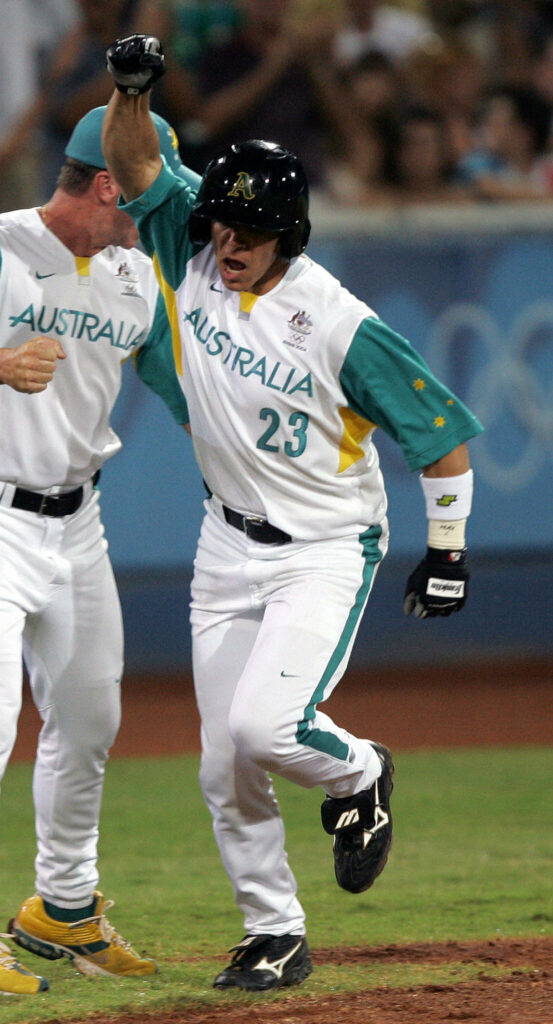
Lloyd (below) even drew on some of his Major League Baseball experience in the biggest of stages.

“He told how when he was with the New York Yankees in 1996 when they were down two games in the World Series against Atlanta, but got up. He said, you just have to keep executing.”

“That was our approach, to keep executing and not worry about the score. That’s right through, the coaches, the players, the EO and the physio. We all have a job to do, and to just keep executing.”

Australia now finds themselves in an 0-2 hole to start the Olympic campaign.

It’s effectively a do-or-die game vs Italy tomorrow, with Japan coming up after that. Only the top four teams advance to the semi finals.

Here are the other scores from Day 2 of the 2004 Olympic Baseball tournament:
– Japan 8 (2-0) def Netherlands 3 (1-1)
– Canada 9 (2-0) def Italy 4 (0-2)
– Cuba 5 (2-0) def Greece 4 (0-2)

Standings After Day 2
1. Japan 2-0
2. Canada 2-0
3. Cuba 2-0
4. Netherlands 1-1
—
5. Chinese Taipei 1-1
6. Greece 0-2
7. Australia 0-2
8. Italy 0-2

Top four advance to semi finals.

Other stories:
– Game 1 Recap: Australia vs Cuba
– Preview: Australia looks to learn from success and failures past ahead of 2004 Olympics
– Roster: Meet the 2004 Australian Olympic Baseball team
Tag Cloud:
2004 Olympics

15 August 2024 By Staff Writers

By Staff Writers

History: Olympics

2004 Olympic Baseball: Australian bats silent in tight opening game loss to Cuba

by Robert Laidlaw | 2004 OLYMPIC BASEBALL – Greece, August 15, 2004 – 

This story is part of a series running on baseball.com.au from August 15-25 commemorating the 20-year anniversary of the 2004 Australian Olympic Baseball team. Each day will feature a recap and story as if the tournament is happening now. Scroll to bottom of this story for more links and recaps.

Australian bats stifled by reigning silver medalist Cuba in opening game of 2004 Olympics

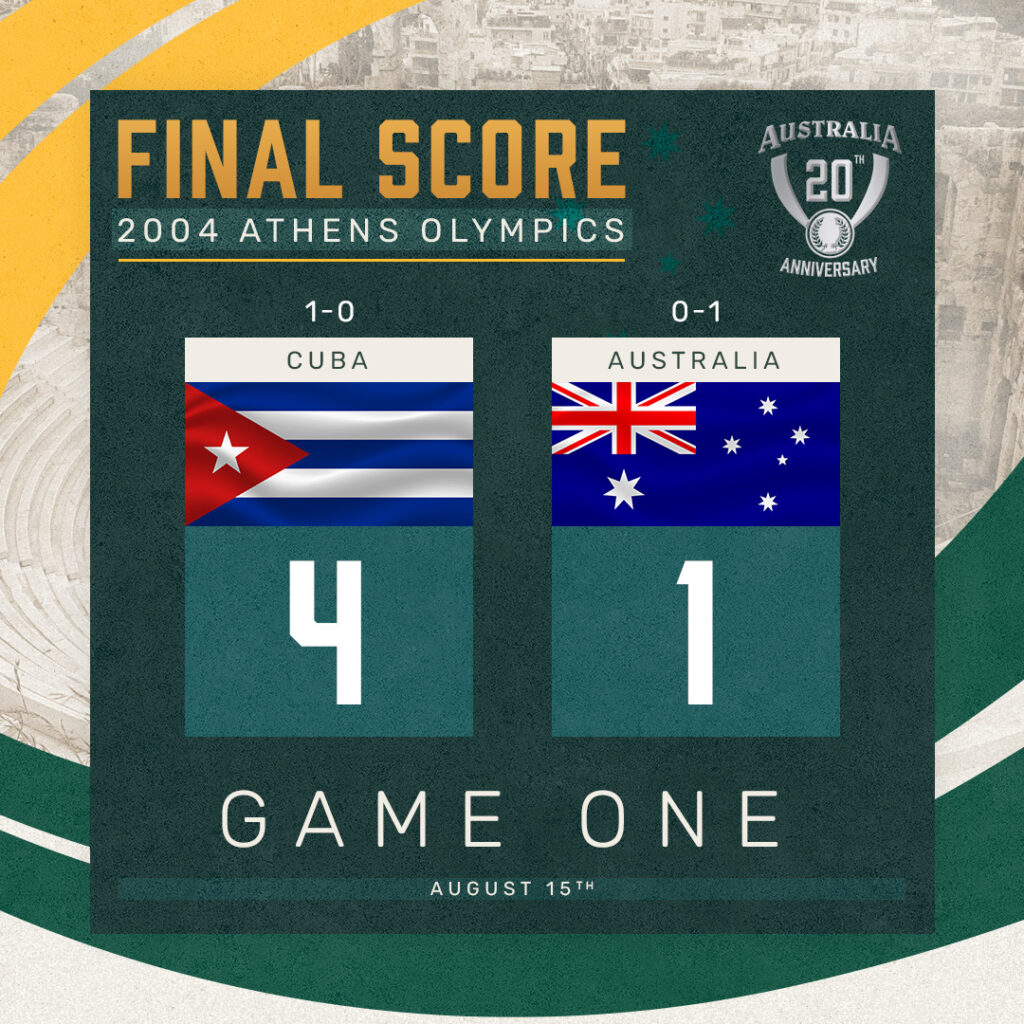
Australia has opened their 2004 Olympic baseball tournament in Greece with 4-1 loss to Cuba. Two Australian fielding errors and two Cuban home runs did the bulk of the damage.

Michel Enriquez gave Cuba a great start with a one-out home run in the bottom of the opening inning.

A pair of errors set up a second run for Cuba in the third frame, while in the sixth inning, Osmani Urrutia put another one out and over the fence for a 3-0 advantage.

Australia was struggling with the bat.

Over the first six innings, Australia managed just one infield single and a walk and failed to get a runner to second base.

Cuban starter Adiel Palma tossed eight innings of two-hit baseball to shutout the Australians with five strikeouts and one walk.

The best chance for the Aussies to score came at the top of the seventh, when Glenn Williams singled with two out and reached second on an error. But, that’s where he was left stranded.

BOX SCORE AND PLAY-BY-PLAY: Click here for detailed stats and box score

An error and a pair of hits helped Cuba extend its lead with a run in the bottom of the seventh, with Australia finally breaking through at the top of the ninth for its only run of the game.

Rodney van Buizen ran out an infield hit, and after two outs, came home on Andrew Utting’s single to leftfield.

Starting pitcher Craig Anderson threw seven innings in taking the loss, conceding nine hits and no walks for three K2s. Adiel Palma spearheaded Cuba’s win from the mound, giving up two hits and a walk for five strikeouts in eight frames.

“It was disappointing for us, losing that first game, but they threw some good pitching at us,” manager Jon Deeble (below) said. “It was just the first game, so we need to regroup quickly, as it’s a short tournament and every win counts.”

Australia must regroup quickly. They play Chinese Taipei tomorrow, August 16, in their second game. Chinese Taipei dropped their opening game 7-0 to Canada.

Australia must finish in the top four to progress to the semi-finals of the tournament.

Here is a look at the other scores from Day 1 of Olympic action:
– Canada 7 def Chinese Taipei 0
– Japan 12 def Italy 0
– Netherlands 11 def Greece 0

Standings:
1. Japan 1-0
2. Netherlands 1-0
3. Canada 1-0
4. Cuba 1-0
—
5. Australia 0-1
6. Chinese Taipei 0-1
7. Greece 0-1
8. Italy 0-1.

Top four advance to semi finals.

Other stories:
– Preview: Australia looks to learn from success and failures past ahead of 2004 Olympics
– Roster: Meet the 2004 Australian Olympic Baseball team


Tag Cloud:
2004 Olympics

13 August 2024 By Staff Writers

By Staff Writers

History: Olympics

2004 Olympic Preview: Australia looks to draw on past success, prior mistakes ahead of Athens

by Robert Laidlaw

Note: This story is part of a collection in a series celebrating the 2004 Australian Olympic baseball team. Each day between August 15 and 25 we will recap Team Australia’s games, replaying the tournament in “real time” with stories from Robert Laidlaw.

Can Australia win a medal at the 2004 Olympic baseball tournament in Greece? That is the big question, as the Aussies look for some redemption after failing to win a medal in Sydney four years earlier.

Setting the stage: International promise


It was just five years ago Australia sat atop the international baseball world. They won a gold medal at the 1999 Intercontinental Cup, with a 4-3, 11-inning thrilling climax in Sydney against Cuba.

Medal hopes were high for the 2000 Olympic campaign but Australia came up short. A 2-5 win-loss record had the Australians finishing seventh.

Losing to Italy and the Netherlands put Australia out of contention for a medal at the Sydney games.

There was a new coach in 2000.

Former Australian coach Mike Young, who led Australia to its gold medal victory in 1999, was replaced by Jon Deeble – a great Australian national team mainstay transitioning out of his playing career.

The nucleus of the team remained in tact, including the leadership of Australia’s MLB All-Star David Nilsson.

MEET THE ROSTER: 2004 Athens Olympics Squad. 

Nillson said the team could draw on memories from the 1999 campaign.

“In 1999 it worked well, as the tournament (Intercontinental Cup) was in November and I had finished my season with Milwaukee after breaking my thumb six weeks earlier,” Nilsson said.
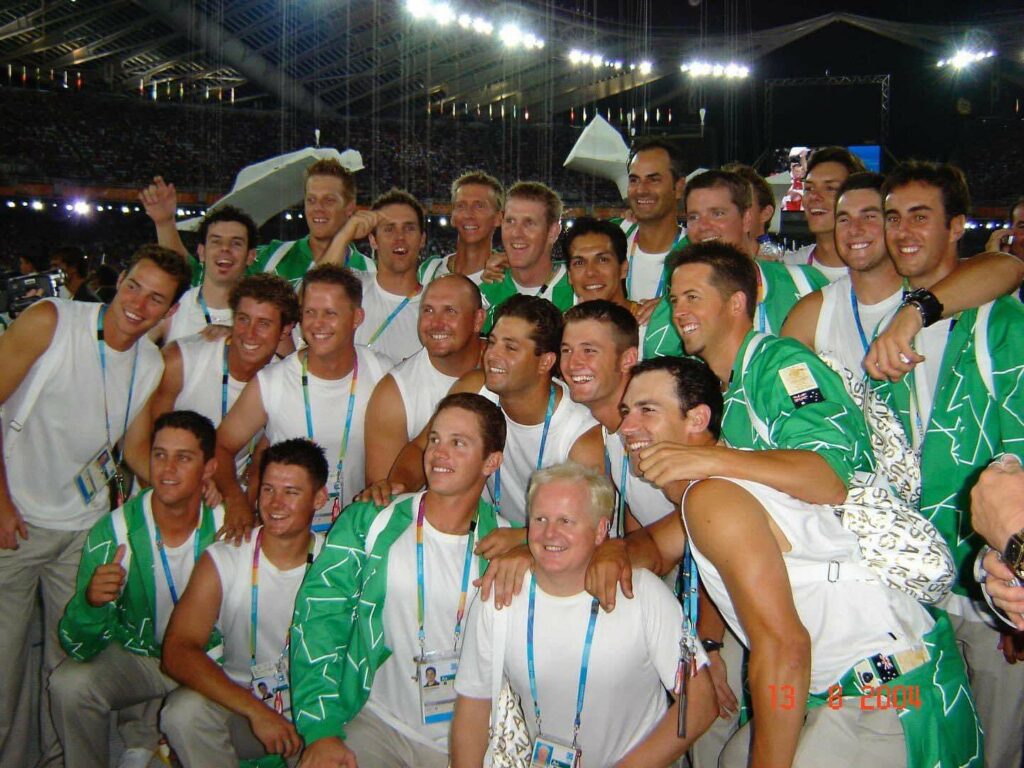
“I had not played a tournament for Australia previously and I knew we were a chance to win a medal. Personally, it was nice to win a few awards (Nilsson was the MVP of the tournament), but winning a gold medal was special – Australia’s first in senior competition.”


There was a big team mentality of that 1999 bunch.

“Winning was so important, especially when Gary White came off the bench to drive in the winning run against Cuba in the final,” said Nilsson. “He was a veteran guy who had not played much in the tournament but was ready mentally and ready for any situation, and in extra innings with a guy on base, it was a good match-up.”

But things changed just a year later in front of Australian home fans in a Sydney Olympics.

“In 2000 (Olympics) we failed miserably,” stated Nilsson. “Between 1999 and 2000 we had a change of leadership – the whole DNA, the make-up changed, we were a different team. We were positioned to do something at home, but with the changes made we weren’t ready to play, and it showed in our performance.”

“Athens was absolutely about correcting the wrong.”

But this is a different beast. It’s tournament baseball. And, it’s the Olympics.

“The thing about Olympic baseball is that it is a 10-day tournament. In many of the other events, athletes compete for a few days then party and celebrate – we had to forget it was the Olympics and just treat it like a normal baseball tournament,” said Nilsson, then 34.

“The take away for us was that we had a bunch of young guys playing in a pretty big moment, which they had never experienced, so we needed to make sure we were prepared for Athens.”

Nilsson played for Milwaukee Brewers in MLB from 1992-99, batting .284 with 105 home runs and 470 RBIs. In his final MLB season he became the first Australian to play in the All-Star game.

In 2000 Nilsson signed with the Chunichi Dragons in Japan so he could play in the Olympics for Australia. Alhough it was an unsuccessful tournament for the team, he led the competition batting averages with a .565 mark.

A new coach

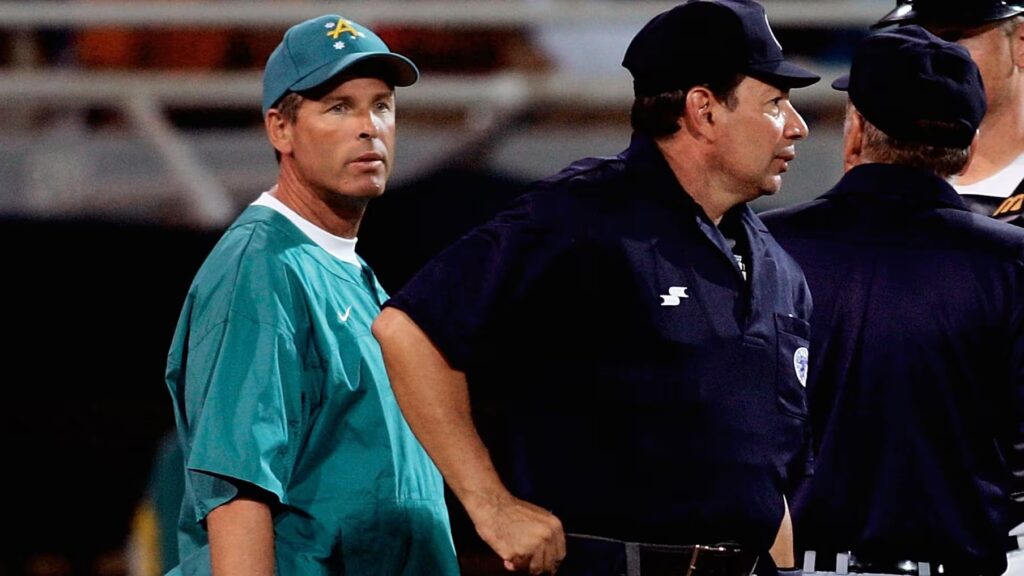
Jon Deeble played for Australia at the international level from 1983-95 as a pitcher, including the 1988 Olympics.

When Australia won the 1999 Intercontinental Cup, Deeble was a coach and in the turmoil of leadership changes, was appointed manager for the 2000 Olympics.

“That success in 1999 was fantastic,” Deeble said. “I was the bench coach and that team was pretty special.”

The 2000 Olympics didn’t go as planned for Deeble.

“As for the manager’s job for 2000, it was thrown on me late and I wasn’t ready, as the results indicated,” he said. “I put a lot on me but I wasn’t ready. It was just four years after I had played. But you don’t get anywhere without failures, so going into Athens there were lessons learned to fall back on.”

For the 2004 games, Deeble has enlisted some help from the outside.

“After 2000 I did a lot of work with performance psychologist Dr Phil Jauncey, who taught me so much – I spent hours on the phone or in person with him. He helped me and the coaching staff,” he said.

“Our mentality going into Athens was that it’s up to the players – let them play! We had experienced guys who had played professionally, like (David) Nilsson, (Chris) Oxspring, (Graeme) Lloyd, as well as some younger guys who had played at this level for several years.”

Roster & Qualification

The turnover of the roster from the 2000 Olympics to 2004 was amazingly high with just six players remaining in Nilsson, Rodney Van Buizen, Craig Anderson, Brett Roneberg, Paul Gonzalez and Glenn Williams.

To qualify for the Athens Olympics, Australia beat South Africa at Blacktown in Sydney. They won all three games –  8-1, 6-4 and 13-1.

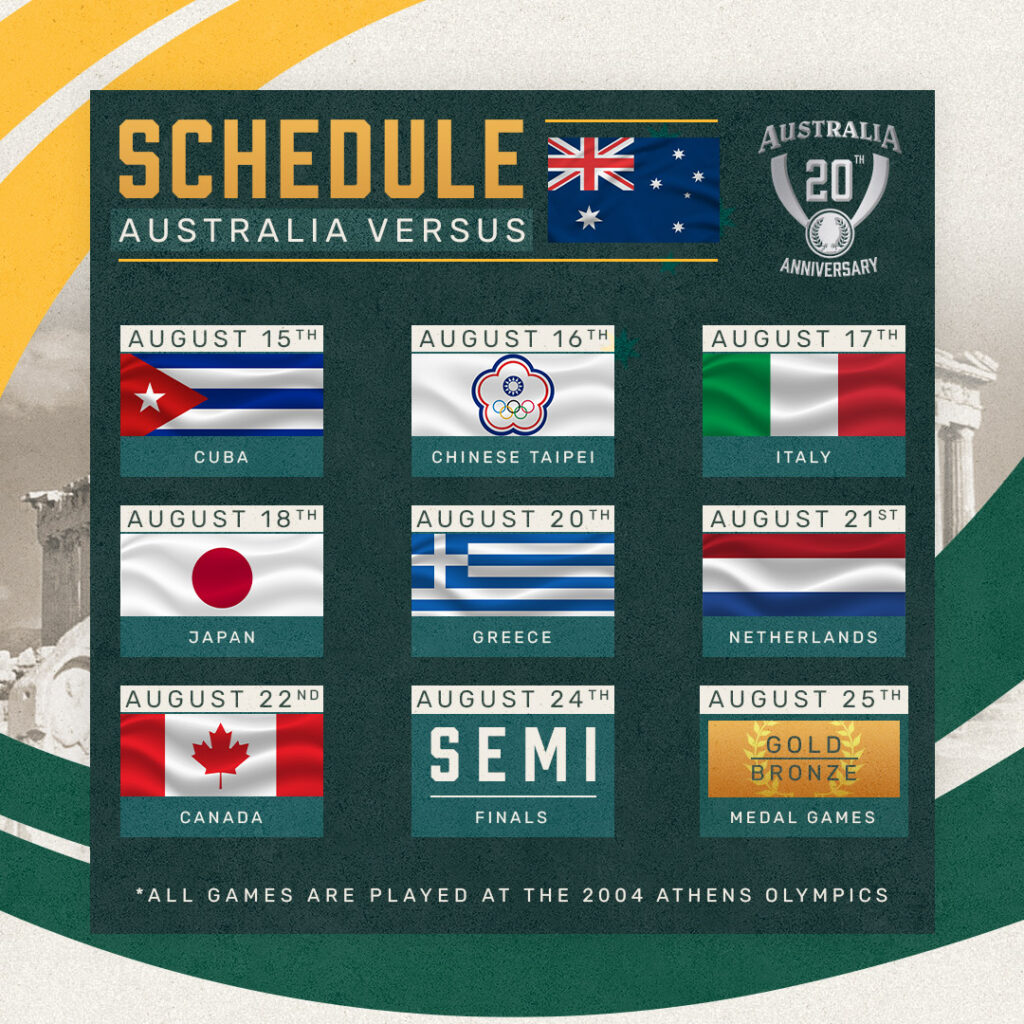
Australia’s program for the 2004 Olympics: August 15 v Cuba; August 16 v Chinese Taipei; August 17 v Italy; August 18 v Japan; August 20 v Greece; August 21 v Netherlands; August 22 v Canada.

Team Manager – Jon Deeble; Coaches – Tony Harris, Paul Elliott, Phil Dale.

Pitchers – Craig Anderson, Adrian Burnside, Graeme Lloyd, Wayne Ough, Chris Oxspring, Ryan Rowland-Smith, John Stephens, Phil Stockman, Rich Thompson, Jeff Williams

Hitters – Tom Brice, Gavin Fingleson, Paul Gonzalez, Nick Kimpton, Brendan Kingman, Craig Lewis, Dave Nilsson, Trent Oeltjen, Brett Roneberg, Brett Tamburrino, Andrew Utting, Rodney van Buizen, Ben Wigmore, Glenn Williams.

Tag Cloud:
2004 Olympics

11 August 2024 By Eric Balnar

By Eric Balnar

History: Olympics

2004 Olympic Baseball: Meet the Aussies looking for a medal at the 2004 Athens Olympics

There’s no doubt about it. This 2004 Olympic team is one of the most iconic baseball rosters ever assembled in Australian history.

They also accomplished something remarkable – a 2004 Olympic silver medal, Australia’s only hardware from an Olympic Games.


There’s just one problem -itt’s really hard to find succinct game stories, photos, box scores and information about this incredible Olympic run.

Until now.

Over the next fortnight, we will be relieving the 20-year-anniversary of this team in all its glory. In fact, we’ll just pretend like the tournament is happening “now”.

Australian baseball writer & historian Robert Laidlaw will provide a game recap with quotes from some of the players who lived the games themselves to help paint a picture. We’ll have a mini-booklet to distribute at the end of it.

From August 15-25 on baseball.com.au and Team Australia Baseball social media accounts, we will wind back the clock.

We’ll post each recap based on the schedule below. There will also be a preview before the tournament “begins.”

There’s no doubt the competition would be stiff. Only the top four teams can advance to the medal rounds after playing each other once.

Looking back, this Australian team was loaded with pedigree. There were ten Major Leaguers on this team, seven of them pitchers.

There were six returning from the 2000 Olympic squad.

Stay tuned for an official preview. Let’s meet the squad.

POSITION PLAYERS

C David Nilsson: Arguably Australia’s most prolific player, Nilsson captained the side in 2004. Nilsson spent eight years in the Major Leagues with the Milwaukee Brewers in the 1990s and was an MLB All-Star in 1999. He was part of the 2000 Olympic squad and a real leader for baseball in Australia. Nilsson also played a season in Japan’s top league.

C Andrew Utting: The 26-year-old reached as high as Triple-A with the Orioles in 1998 but has been out of professional baseball since 2000. He has been playing Claxton Shield with the Queensland Rams.

C Ben Wigmore: A 22-year-old South Australian rising through the ranks in his home state, with the opportunity to provide some depth to the squad.

1B Brendan Kingman: The 31-year-old reached as high as Double-A in his career back in 1999. He is the Australian Baseball Leauge’s single season record holder in homers with 27. Currently playing for NSW in the Claxton Shield.

2B Gavin Fingleson: After playing three years of independent league professional baseball in the early 2000s, 27-year-old Fingleson played a season of independent baseball in the North East League to prepare for the Olympics.

SS Rodney Van Buizen: A versatile infielder, 23-year-old Van Buizen spent the season in High-A in the LA Dodgers organisation. He hit .326 in High-A in 2003.

3B Glenn Williams: The 27-year-old signed a hefty contract as a teenager in 1994 with the Atlanta Braves. In 2004, he was in the middle of his third straight Triple-A season with the Toronto Blue Jays, hitting .264 and knocking on the door of the Major Leagues. Williams eventually reached the Major Leagues with Minnesota in 2005.

UTIL Craig Lewis: A member of the national team since 1997, Lewis has transitioned from being a reliable pitcher to a hitter. He hit .261 for the Brockton Rox in 2004, an independent league

UTIL Brett Tamburrino: The 22-year-old, who can play both infield and outfield, spent 2004 in High-A with the Minnesota Twins where he hit .271.

UTIL Paul Gonzalez: The 35-year-old returns to the Olympics from the 2000 team as a leader. He reached as high as Triple-A in the 90s with the San Diego Padres and played in the top-level of Japanese baseball in 1999. Currently with the Queensland Rams in the Claxton Shield.

OF Tom Brice: The 22-year-old hit .310 in A-Ball with the Chicago White Sox in 2004. In 2005 he played in the top level of Taiwanese baseball.

OF Brett Roneberg: The 25-year-old spent 2004 in Double-A with the Boston Red Sox where he hit .279. He previously had reached as high as Triple-A with the Marlins. Roneberg had a lengthy 11-year career as a minor leaguer.

OF Trent Oeltjen: A young 21-year-old future MLB player who hit .278 in High-A with the Minnesota Twins in 2004. Oeltjen would make his MLB debut five years later in 2009 and play parts of three seasons in the Show.

OF Nick Kimpton: 20-year-old Kimpton was in the midst of a fine season in A-Ball with the Anaheim Angels, hitting .290.

PITCHERS

LHP – Jeff Williams: The 32-year-old had already pitched parts of four seasons in Major League Baseball with the LA Dodgers, but he really made his name in Japan. In 2003 with the Hanshin Tigers in the top level of Japanese baseball, Williams posted a 1.54 ERA in 52.1 innings of relief.

LHP – Ryan Rowland-Smith: The 21-year-old from Newcastle feels destined for the Major Leagues. In 2004, he was in the middle of a season in High-A with the Seattle Mariners. By 2007, Rowland Smith would make his MLB debut. He went on to pitch over 120 games in the Major Leagues.

RHP – Rich Thompson: The newly turned 20-year-old from Hornsby was enjoying success in High-A with the Angels. Thompson would eventually make his Major League debut in 2007 and pitch parts of six seasons and 104.1 innings.

RHP – Wayne Ough: The 25-year-old reached his highest level of minor league baseball in 2004 – Double-A with the New York Mets. After his minor league career ended, Wayne Ough embarked on almost a two-decade career playing all over Europe and in Australian in the ABL.

LHP – Graeme Lloyd: The 37-year-old had just finished a 10-year Major League career which included two World Series rings. Lloyd pitched over 500 MLB innings for the Milwaukee Brewers, New York Yankees, Toronto Blue Jays, Montreal Expos, Florida Marlins, New York Mets and Kansas City Royals.

RHP John Stephens: The 24-year-old was in the midst of a Triple-A season with the Boston Red Sox. Stephens, from Sydney, had already made his Major League debut in 2002 with the Baltimore Orioles.

LHP Craig Anderson: From Gosford, Anderson was 25-years-old at the time and enjoying some success at Triple-A in the Mariners organisation. His professional career extended an illustrious two decades, with nine seasons in the minor leagues and ten in the Australian Baseball League.

RHP Chris Oxspring: In 2004, Oxspring was a 27-year-old knocking on the door of the Major Leagues in Triple-A. He made his Big League debut in 2005 with the San Diego Padres. Oxspring eventually pitched in top-level Japan and Korea. He pitched an inning of professional baseball in the 2023-24 ABL season.

RHP Phil Stockman: The 24-year-old split time in Double-A and Triple-A in the Arizona Diamondbacks organisation in 2004. He ended up pitching parts of two seasons with the Atlanta Braves in 2006 and 2007.

LHP Adrian Burnside: The 27-year-old was in Triple-A at the time of the Olympics. He ended up pitching four seasons in Triple-A. Burnside made his mark in Japan, pitching in the top level for the Yomuiri Giants for three seasons. He also pitched a year in Korea.

Tag Cloud:
2004 Olympics

24 August 2019 By baseball.com.au

By baseball.com.au

- Team Australia Left Field

#OTD in 2004: Australia advances to Athens gold medal game

On this day in 2004 Australia ensured it would return home from the Athens Olympics with a medal in hand.

Australia edged Japan 1-0 in thrilling semi-final at the Olympic Baseball Centre, setting up a battle for gold with Cuba.

Tag Cloud:
#OTD2004 OlympicsAthens OlympicsAugust 24Brendan KingmanChris OxspringOlympicsOn This Day
Sponsored
  • History: Olympics over 1 year ago 2004 Olympic Baseball: Australia wins Olympic silver after Cuba wins dramatic Gold Medal match
  • History: Olympics over 1 year ago 2004 Olympic Baseball: Australia stuns Japan in Olympic baseball group stage upset
  • History: Olympics over 1 year ago 2004 Olympic Baseball: Australia storms back from five runs down to beat Greece
  • History: Olympics over 1 year ago 2004 Olympic Baseball: Tournament back on track as Australia picks up first win over Italy
  • History: Olympics over 1 year ago 2004 Olympic Baseball: Australia in early hole after dropping second Olympic game to Chinese Taipei
  • History: Olympics over 1 year ago 2004 Olympic Baseball: Australian bats silent in tight opening game loss to Cuba
  • History: Olympics over 1 year ago 2004 Olympic Preview: Australia looks to draw on past success, prior mistakes ahead of Athens
  • History: Olympics over 1 year ago 2004 Olympic Baseball: Meet the Aussies looking for a medal at the 2004 Athens Olympics
  • Left Field over 6 years ago #OTD in 2004: Australia advances to Athens gold medal game
Baseball.com.au Logo
  • Our Network
  • Baseball.com.au
  • ABL
  • Team Australia
  • Baseball Australia
  • More
  • Baseball+
  • Baseball Photos
  • Contact Us
  • Careers
  • Submit a Story Idea

Baseball.com.au is a division of The Australian Baseball Federation. The Australian Baseball Federation is the peak representative body for baseball in Australia. The Australian Baseball Federation has national and international regulatory and coordination responsibilities. In performing those functions, the Australian Baseball Federation uses the descriptor: "Baseball Australia". (0.0.0)

Subscribe to monthly newsletter
Baseball.com.au Shop
Play Baseball
© 2026 Baseball.com.au. All rights reserved. (0.0.0) Privacy Policy Terms & Conditions
Website design by Thirst Creative