11 November 2023
How a Japanese city is helping Australian women's baseball
by Kristin Sims, women’s baseball reporter for Baseball.com.au. Got a story idea? Email us at playbaseball@baseball.com.au.
FORWARD – In August 2023 a partnership between the Fukuoka – a prefecture located on the Japanese island of Kyushu – and Baseball New South Wales was struck, with the aim of developing the women’s game for both countries.
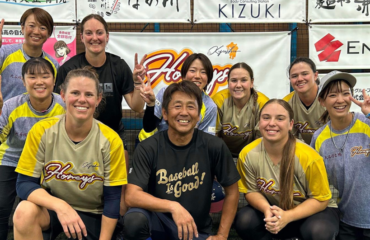
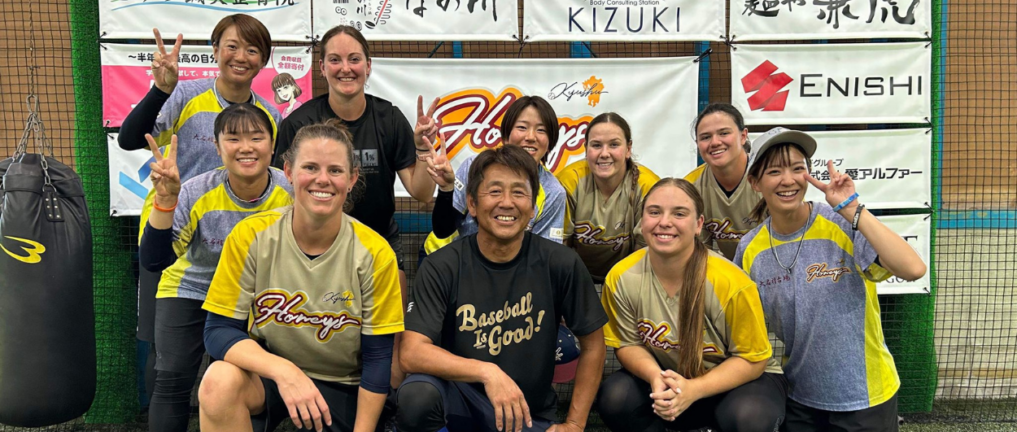
Earlier in November, the first trip of the partnership saw some of the country’s top female players head to Japan to train and play with the Kyushu Honeys women’s team.
Four New South Wales (NSW) players – Ticara Geldenhuis, Jordan Richardson, Maddi Heath and Claire O’Sullivan – were selected to head to Japan to immerse themselves in Japanese baseball culture. All four are members of Australia’s national team, the Aussie Emeralds.
O’Sullivan – one of Australia’s most prominent female players, who represented Australia in the recent Women’s World Cup – was on the trip. She sat down with Baseball Australia to reflect on the trip and what she hopes it will bring for the game in Australia moving forward.
Aussie Emerald Claire O’Sullivan says we can learn a lot from how Japanese baseball players approach the sport.
The New South Wales-based player was one of four baseballers who joined the Kyushu Honeys for a six-day trip in Japan. They took part in their training programs and played exhibition games vs a local boys’ team and a university squad.
Australia is in Japan playing in the Asia Professional Baseball Championships. Watch on Baseball+.

For O’Sullivan, seeing the Kyushu Honey’s training schedule instantly highlighted a stark difference between the two countries programs. It was intense.
“They had a training schedule that was from 8am-12pm every day and it showed that they are more developed and at a higher standard than what we are,” says O’Sullivan.
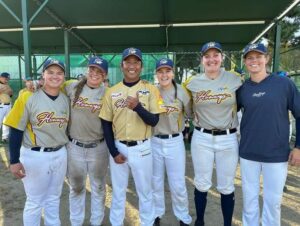
In Japan, the pathways in women’s baseball have developed to include High School Leagues and strong amateur leagues. The chance for female baseballers to play at University and in a professional league helps make Japan the #1 women’s team in the world.
O’Sullivan hopes the partnership will be able to create a similar system for women’s baseball in Australia.
“For us, it is about what we can do to build up and develop women’s baseball in NSW. While we have a couple of tournaments we can play in during the year, there isn’t a lot of opportunity outside of that,” she says. “It’s about developing that side of it and giving us the opportunity to play against better competition and better players.”
O’Sullivan says she can use some of the highlights of the Japan trip in Australia. She can share knowledge with NSW’s current and next generation of baseball players.
The Honeys had three Japanese national players on their team. O’Sullivan says their training and preparation for games is not what she’s used to seeing. She has already brought that back home to her club.
“Getting to see what those players do every single day, how they go about their training with an intent at a completely different level to what I have ever seen across any other level,” said O’Sullivan.
“They have a completely different vibe to how they respect the game, their coaches and their team. It a different culture to what we have but something that I am already trying to implement at a club level,” she says.
One area she identified is the approach to trainings.
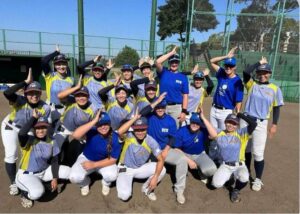
“I feel that intensity is something that can be dramatically improved and by starting small at a club level, hopefully it will flow through to our state team and other levels as well,” she says.
O’Sullivan says she hopes opportunities like these overseas trips will get more women involved in baseball.
O’Sullivan says the experience was eye-opening. She says the wide range of talent in Japan across different age brackets made her identify an area of concern for the game in Australia – player numbers between the ages of 15 and 21.
Although this problem is not isolated to just baseball in Australia, if there are smaller participation rates than the loss of a few players can harm clubs in the long term.
O’Sullivan thinks this is something the partnership could assist with, by showing players that there are a wide range of pathways for the sport aside from the annual national championships.
“I would like to see us send teams over to Japan in the months that we are not training for nationals,” O’Sullivan says.
“We do have a really strong under 15 and 16 program in NSW but we do see a lot of players dropping off in that age bracket who aren’t quite at the state level yet. It would be good to see something available for them to play in whether it is a tournament overseas or a training camp,” she says.
O’Sullivan is already quite active in the women’s baseball scene, outside of her prolific playing career. She is already actively engaging in the 15-21 age group by coaching youth teams – like the NSW squad that went to the Barclay Cup earlier this year. She is active at her club and in the NSW community in giving young women a chance to play.
“If these girls can see that there is something else for them to aspire to, then it will become something that can help keep them in the game.”
Players in New South Wales are about to be exposed to the high-level of Japanese baseball.
The second step in the partnership will see Fukuoka send a team to Australia in December to replicate the Australian’s trip. Orio Aishin High School will be here with a group of players. There will be games and trainings happening throughout the Sydney leg of the tour.
NSW will host the Japanese players and provide accommodation like they received when they were in Japan. The hope is that the NSW state teams will be picked by then and they can use the opportunity to play some exhibition games before the national 2024 championships.
“With them sending over a junior team it would be great to have our train-on squad ready to play against that team in preparation for nationals.” said O’Sullivan.
Keep an eye out Baseball.com.au for more information on Women’s baseball.