28 December 2025
Australian Youth Championships
Preview and Rosters | Western Australia at the U16 and U18 Baseball Championships
Western Australia certainly has a knack for tournament baseball.
Over the last few years, we’ve seen Western Australia regularly medal at events of all shapes and sizes.
At the 2025 Australian Youth Championships, they were one of two states to medal in both divisions.
Western Australia repeated that feat at the Women’s and Youth Women’s Championships.
READ ALL PREVIEWS AT THE TOURNAMENT HUB: 2026 Australian Youth Championships
In charter competition, they’ve dominated. In fact, the 2025 Wanneroo Giants and 2024 Eastern Phantoms made some of the deepest runs we’ve seen from an Australia side at the Senior League championships. Many of those players factor in across the WA rosters.
Experience, pedigree, pride and an understanding of tournament baseball may help Western Australia drive home some more hardware in Melbourne.
Let’s meet the teams.
U16 WESTERN AUSTRALIA: VERSATILE, INCLUSIVE, AND BUILT TO COMPETE
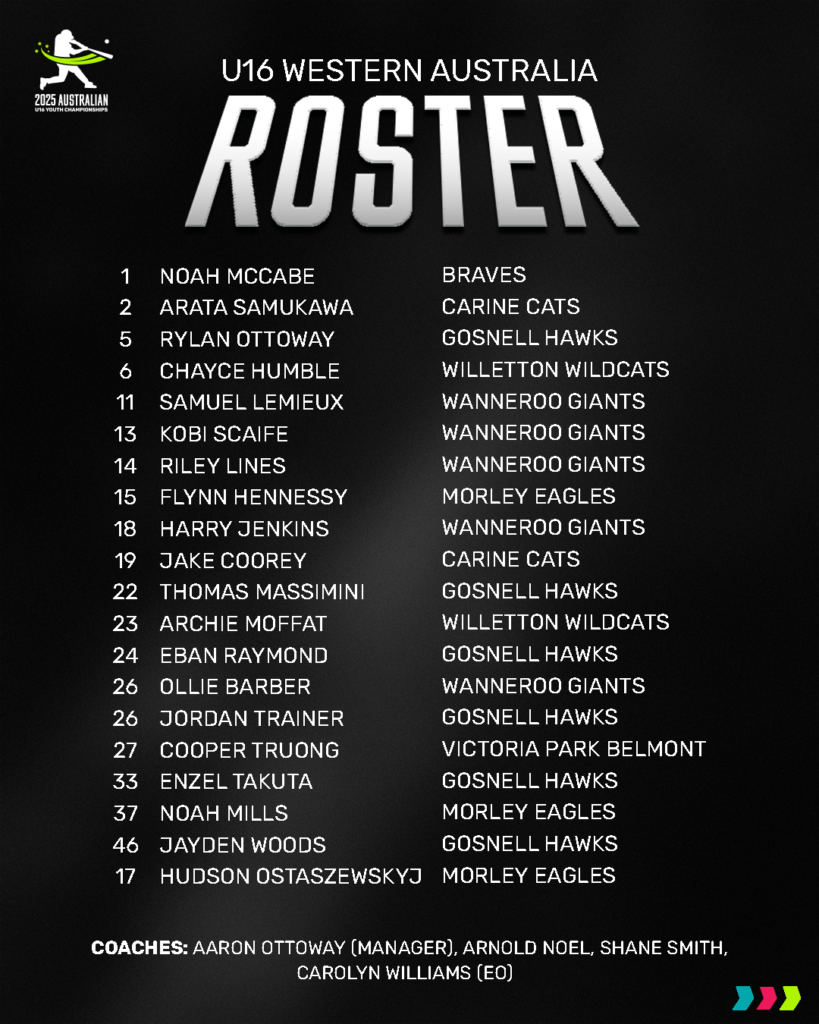
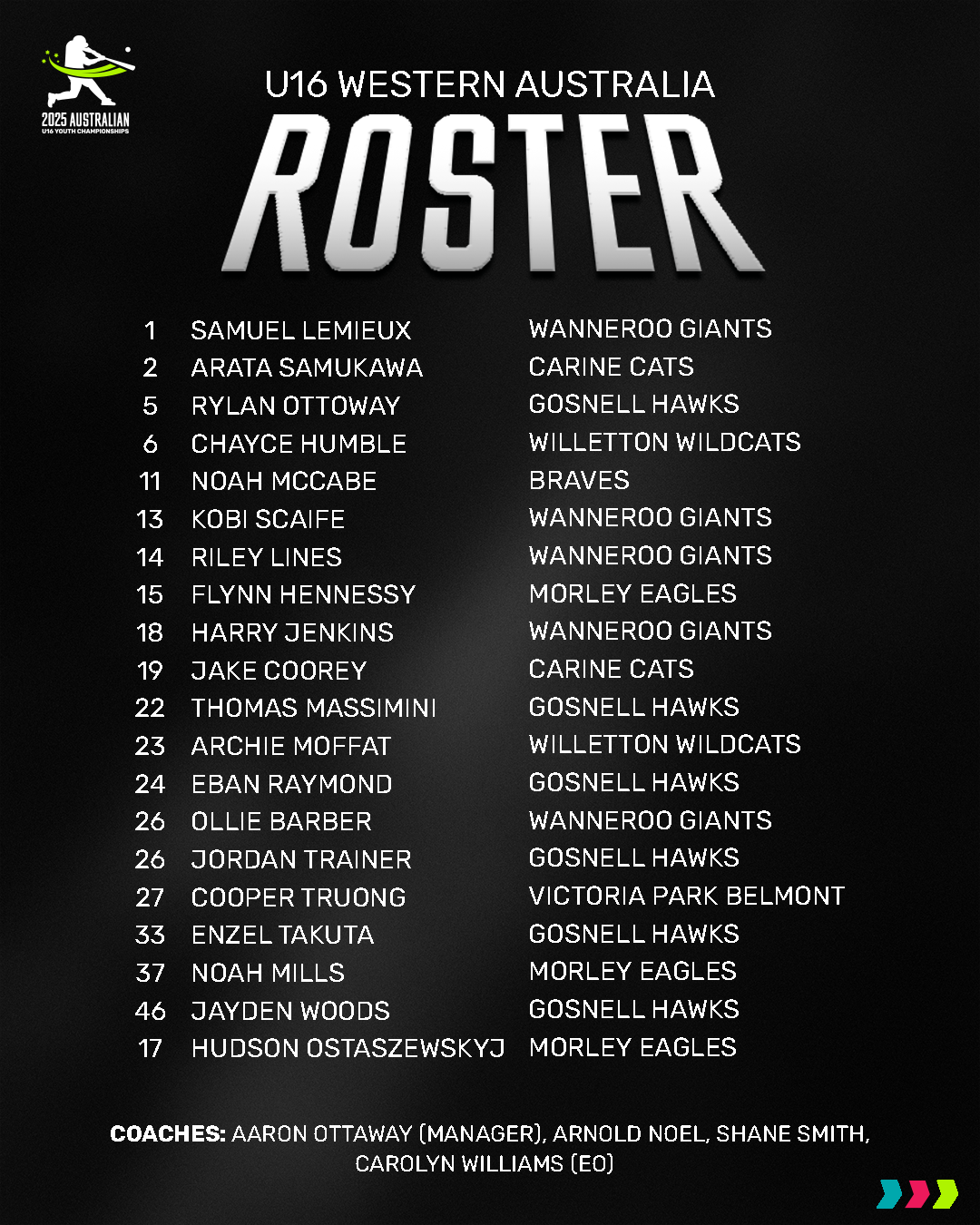
Click here for roster.
2025 Result: Bronze Medal
Western Australia enters the Australian Youth Championships with a U16 group shaped around adaptability, effort, and a clear expectation to compete deep into the tournament.
Coached by Aaron Ottoway, this WA side has been prepared with a simple focus: build a connected group, define roles, and be ready to perform when it matters most.
“The expectation is to compete for a medal in January,” Ottoway said.
Preparation has been efficient and purposeful. The squad has trained twice a week through the lead-in, before ramping up across the final days prior to travel. Rather than overload, Ottoway has emphasised quality and clarity.
“Having players that can fulfil certain specific roles was a key factor in finalising the roster,” he said.
That thinking has shaped the identity of the group. WA’s biggest strength, according to Ottoway, is versatility — players who can move between roles and contribute in different ways.
“Most of the team has the ability to play multiple roles and contribute in different aspects,” he said. “That versatility will help us achieve team success.”
Players have echoed that flexibility across the group.
“We don’t really have any holes in our team,” outfielder Flynn Hennessy said.
“We have a lot of depth and get along really well,” pitcher Noah Mills added. “We work well as a team and know each other’s strengths.”
That versatility has gone hand-in-hand with a strong cultural foundation. From the outset of camp, the group has focused on inclusivity and connection.
“The team is very inclusive and have transitioned well, creating a solid team environment,” Ottoway said.
Catcher Jake Coorey pointed to chemistry as a defining strength.
“Probably our chemistry,” he said, when asked what sets the group apart.
On the field, the biggest growth has come in how players approach learning, communication, and execution.
“Adapting to new ways of learning the game and expectations has been a big improvement,” Ottoway said. “Raising default levels at practice to get better and improve every day as a group.”
Training sessions have been built around detail. Communication has been prioritised, particularly on defence, along with developing internal clocks and sharpening execution offensively. For pitchers, controlling the running game has been a key focus.
“Pitchers working quicker to the plate to control the running has been important,” Ottoway said.
Several players pointed to defence and fielding as areas of pride.
“Our defence,” utility Hudson Ostaszewskyj said, when asked about the team’s biggest strength.
Shortstop Enzel Takuta added that clean fielding has been a focus, emphasising the importance of preventing extra bases and bad hops.
That attention to detail reflects how WA traditionally plays the game.
“We’ve always played a scrappy brand of baseball as a state,” Ottoway said. “Our ability to compete has made WA a tough team to play for many years.”
One player posed to make an impact on the national stage is Arata Samukawa. The returning infielder and pitcher has put together a strong off-season and brings multiple tools to the lineup.
“He’s had a really big off-season in the gym and on the field,” Ottoway said. “He’s a plus runner with good baseball IQ, can run havoc on the bases, and is a switch hitter with solid contact skills.”
Samukawa’s teammates have noticed as well.
“One of our strongest players,” Hennessy said. “He’s looking to have a big tournament.”
With versatility across the roster, a strong team environment, and a clear competitive edge, Western Australia’s U16 group enters the Australian Youth Championships ready to test itself against the best — and confident it can stay in the fight.
THREE THINGS TO WATCH
1. Versatility across the diamond
WA’s ability to move players between roles gives them flexibility in-game and across the tournament, particularly in tight matchups.
2. Defensive communication and execution
Internal clocks, cleaner communication, and attention to detail on defence will be central to how WA controls games.
3. Chemistry under pressure
This is a group that knows each other well and genuinely enjoys playing together — a valuable edge when games tighten late.
U18 WESTERN AUSTRALIA: BUILT FOR TOURNAMENT BASEBALL
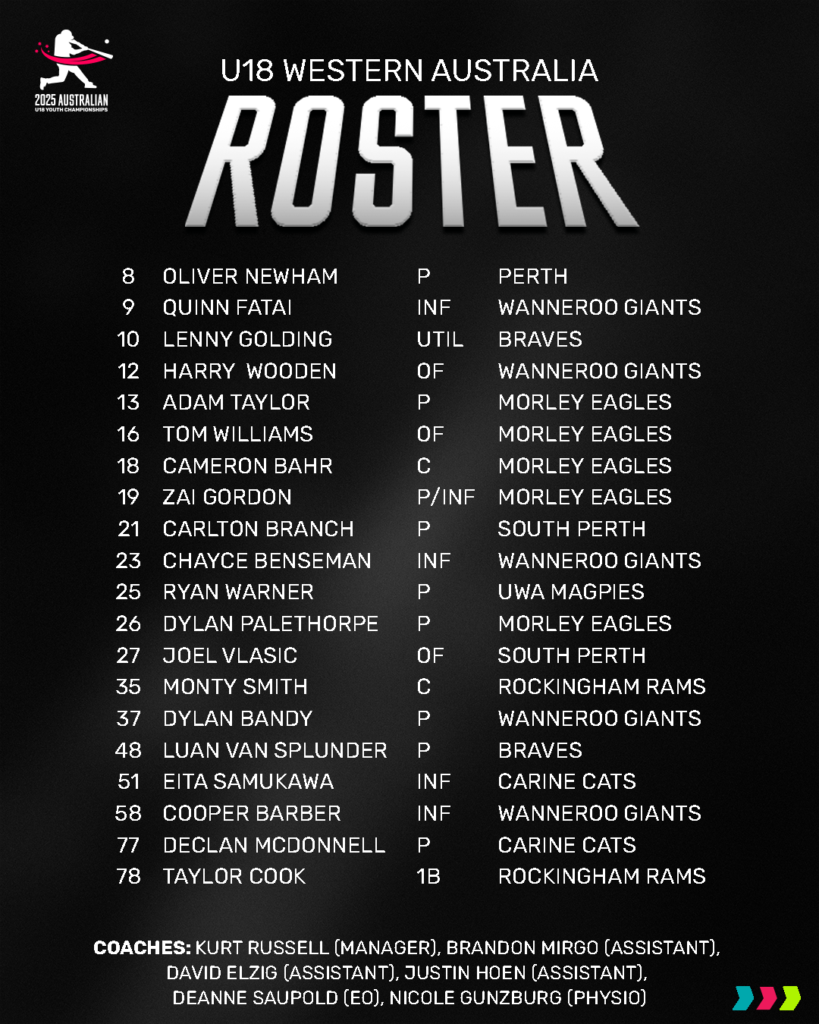
2025 Result: Silver Medal
Western Australia arrives at the Australian Youth Championships with a U18 group that is deeply familiar with the demands of tournament baseball — and confident it can handle them.
Led by head coach Kurt Russell, this WA squad brings together talent, structure, and a rare level of shared experience.
Fifteen players on the roster have previously won some division of a Little League National Championship, representing either the Wanneroo Giants or Eastern Phantoms at least one World Series event in the USA.
Many of them have medalled at the U16 or U18 Australian Championships.
That history matters. It means this group understands pool play, short turnarounds, elimination pressure, and what it takes to perform across a full championship week.
“Medal,” Russell said when asked about expectations. “We believe we have a legitimate pathway to a national championship.”
Preparation has been carefully managed to support that goal.
WA balanced club commitments with state program demands through the early stages, before ramping up in mid-December to sharpen the group ahead of the tournament.
“We’ve had a really good balance between club commitments and the state program as we managed the workload towards our December ramp-up,” Russell said.
That planning reflects how the roster was built.
WA’s biggest strength lies in its construction — clear roles, depth across the board, and enough pitching to withstand the demands of a long tournament.
“Roster construction is our biggest strength,” Russell said. “We’ve got a really good balance of pitchers and position players, with minimal two-way athletes. That allows for a lot of lineup continuity.”
Players say that clarity has translated directly into buy-in.
“General role understanding has been a big focus for us,” return player Lenny Golding said, noting that the group has embraced individual responsibilities within the team structure.
That buy-in is underpinned by continuity.
The majority of this group has played together for the past two years, and that familiarity has shaped the culture and standards within the team.
“They understand what the requirements are,” Russell said. “The culture for this group has been constructed to harbour on-field success.”
That connection is felt throughout the squad.
Pitcher Oliver Newham pointed to the group’s familiarity, noting that many players have competed against — and alongside — each other for years, helping build trust and cohesion.
On the field, WA continues to lean into a long-standing strength: offence. The state has a reputation for producing position players and offensive depth, and this group fits that profile.
“Our lineup has depth one through nine,” outfielder Tom Williams said, highlighting the ability to apply pressure throughout the order. Williams himself has gone deep at a Senior League World Series.
That offensive firepower is paired with pitching depth — a necessity in a metal-bat environment.
“Building out the depth chart and making sure all roles were covered was critical,” Russell said. “From there, we had to ensure we had enough arms to get through the tournament.”
Pitchers have embraced that responsibility.
Dylan Palethorpe said efficiency and attacking hitters early have been key focus points, while Ryan Warner pointed to the strength of the pitching staff as a whole.
Keep an eye on Chayce Benseman and Monty Smith as players poised to establish themselves on the national stage.
Russell also notes the youth amongst the group.
“I’d expect us to be one of the youngest teams in this competition,” Russell said. “The youth coming through is exciting.”
With championship experience embedded throughout the roster, clearly defined roles, and voices that match the ambition, Western Australia enters the U18 Australian Youth Championships with one objective — to be playing meaningful baseball at the business end of the week.
THREE THINGS TO WATCH
1. Championship experience across the roster
With 15 players who have already won a charter National Championship, WA understands how to navigate the rhythm, pressure, and recovery demands of a full tournament week.
2. Lineup depth from top to bottom
WA’s offence is built to apply pressure throughout the order, giving them multiple ways to score and limiting opportunities for opponents to pitch around danger hitters.
3. Pitching depth in a metal-bat tournament
Clear roles and a deep pitching staff will be critical as WA manages innings, matchups, and recovery across consecutive games.