02 October 2026
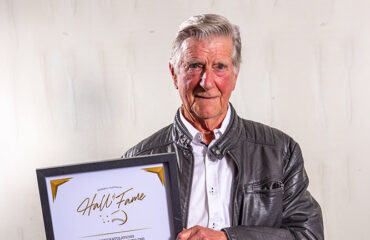
HALL OF FAME STORIES: DON MASTERS GETS HIS CALL TO THE HALL
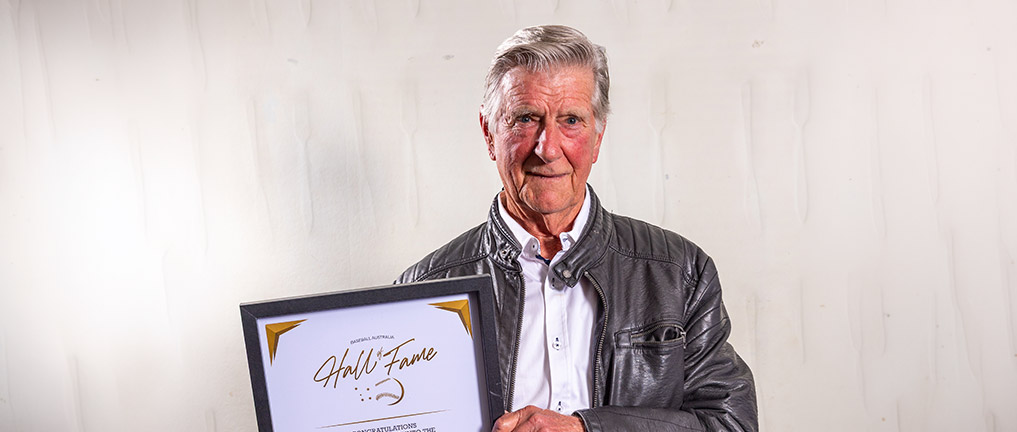
“How good was I at my peak? That’s really for others to judge,” says Don Masters, one of six inducted in the most recent class of the Baseball Australia Hall of Fame.
He’s got one heck of a case to present before the jury.
Don’s resume includes breakthrough moments for Team Australia, six Claxton Shields, a stack of local awards, some truly amazing individual performances, and a mountain of respect from his peers.
He produced viral moments before viral moments existed.
MEET THE INDUCTEES: The 2025 Baseball Australia Hall of Fame Class
When Connor MacDonald tossed three shutout innings vs Japan at the 2026 WBC, he amassed millions of views on X and became a global story. When Travis Bazzana delivered a game-winning, walk-off hit for Cleveland, he made headline Australian news we saw it instantly on our phones. When Tim Kennelly was hunting down records in the ABL, we watched every pitch on Baseball+.
So what would the age of the internet have thought of Don Masters’ historic performance vs Japan in 1971 at the Asian Championships?
Masters helped Australia make history one evening in Seoul, South Korea.
TEAM AUSTRALIA LEGEND
Pitching in front of a reported 40,000+ fans, Masters became the first Australian pitcher to beat Japan in an international series.
Let’s repeat that: The first Australian pitcher to ever defeat the best baseball nation on earth. Keep in mind, at time of publication it’s been 22 years since we beat Japan at the top level…
His stat line? Ridiculous.
A complete-game shutout, allowing just two hits across nine innings.
Masters says he was anxious before the game.
“I liked the plan we had and was quietly confident that if I executed it we were a chance. I knew we had a good field to back me up which always helps,” he says. “[Our coach] Kingsley Wellington asked me to pitch away from the Japanese power batters which was inside. It was a night game and I had particularly good control on my slider, curve ball and knuckle ball which dropped heavily in the air that night.”
He also credits his field, which turned a few key double plays, and the offence led by New South Wales’ Paul Russell, who hit two homers.
“The atmosphere in front of a crowd of 40,000 Koreans was electric as we were not expected to win. You would no doubt be aware that the rivalry between Japan and Korea has existed for many years. We were ecstatic and the crowd were particularly appreciative and demonstrative of our victory,” says Masters. “We hit the headlines of the newspaper the next day and I still have the clippings.”
Masters quickly turns the tale to the game the next day and does what becomes a theme when talking about his career: he celebrates his teammates.
“The next night Neil Page pitched a winning game against Korea (3-2). I remember late in the game, [Victoria’s] John Swanson and [South Australia’s] Phil Alexander were in the outfield being harassed by a section of the crowd who were clanging drink bottles and threateningly calling out their surnames,” says Masters.
Hostile, to say the least.
“We were in fear of our lives trying to get out of the Seoul stadium after that game. It was a trip of many highs and lows all at once,” he says.
His international career continued to elevate in 1975, when Australia returned to the Asian Championships.
They made more history, becoming the first Australian team to win bronze at the tournament.
READ MORE ABOUT DON MASTERS: BaseballSA citation
Overall, Masters played a decade at the top level for the Green & Gold.
“As for the significance for Australian Baseball, I was just quietly proud to be part of it and didn’t think much more about it because there was also a goodwill series to play in Japan afterwards,” says Masters. “I think an opinion for the significance for Australian Baseball is up to others, not me.”
THE LOCAL GAME
Like any great Australian international career, his story begins locally.
In South Australian baseball circles, Masters was already regarded as one of the best.
That will happen when you win six Claxton Shields, represent your state across 12 years, win two premierships and a Best & Fairest, and establish yourself as an elite coach.
“Don was a champion pitcher for his local teams, his state and his country,” says Australian baseball historian Robert Laidlaw, a fellow Adelaide native who has covered Masters for decades. “His pitching ability helped raise the standard of the division one competition. There were other top pitchers at the time in SA but Don was arguably the best of the lot in the 1970s.”
Masters says his first recollection of South Australian baseball was in the 60s, watching Night Baseball every Wednesday at Norwood Oval. He went there as a student at every opportunity to see two high-standard games.
Baseball was also played in most secondary schools. Masters played for Findon High School every Saturday morning, then would head to Woodville Baseball Club to play in lower division games in the afternoon.
His appreciation for the South Australian legends around him is evident.
“I developed a fierce desire to emulate some of the outstanding pitchers I saw at Night Baseball. Fred Medley, Ron Russ, Max Puckett, Don Rice and later Neil Page, Brian Scott, etc,” says Masters. “I had a fascination for pitching and developed some pitches of my own just watching them. We had no coaches at school then and because of overuse I injured my shoulder (rotator cuff) during a Major B game in 62/3 and had to retire for a year. My arm was never quite the same again.”
The injury didn’t stop his impact from being felt locally.
He was named to 12 South Australian sides in the Claxton Shield competition and was part of six national championship squads. It’s regarded as one of the most, if not the most, prolific eras for South Australian baseball.
Masters, again, is quick to deflect to his teammates.
“Our TEAM won six Claxton Shields,” he emphasises.
There it is again. He also has a theory for why South Australia was so dominant.
During the 1960s, baseball was played in the winter months in a 12-team competition, the South Australian Baseball League (SABL). In the summer months, there was a much stronger Night Baseball competition comprising six combined teams.
It was effectively an all-star league. With the calibre of competition, came attention. There was media coverage, including television, and a sponsor’s home run fence.
“There were few other distractions then,” says Masters. “It was particularly difficult to get into the starting side of any combined Night baseball squads. Because of the fierce competition, I believe SA were better prepared for the Claxton Shield National Competitions. Many players came from Interstate to compete including Dick Shirt, Barry Stace, Sid Thompson and Ross Brown to name a few. I played with and against these and many other great players including Kevin Greatrex, David Mundy, Neil Page, Gary Thompson and Adrian Pearce, etc.”
One of his South Australian competitors, Dave Mundy, calls Masters a fierce competitor.
“He was always up for a challenge and willing to use all of his ability and guile to achieve a successful outcome,” says Mundy. “He had great mastery over his variety of pitches and used them to advantage either when we were opponents or team members.”
Masters called Night Baseball his “Mecca” and also a where he thrived.
His accolades extended to the traditional South Australian Baseball League competition, too.
Masters played 220 games across more than a decade for Woodville. He famously helped the club win the 1975 premiership, delivering a standout pitching performance in the decider with ten strikeouts and just two earned runs conceded in a 4–2 victory.
The season before, he won the SABL Infielder of the Year Award.
He later transferred to Northern Districts, where he coached and played. In 63 games with the club, Masters added another significant individual honour, winning the Capps Medal in 1976–77 as the league’s best and fairest player.
Mundy says Masters was not just an asset on the field – but drove the game forward off the field.
“The knowledge and experience he gained at Club, State and Australian level…he was readily prepared to share and impart to others under his guidance and the teams he coached,” says Mundy. “Whether on the field, off the field, he always greeted you with a smile, welcoming challenging or cheekily depending on the situation.”
Ask Masters for some of his other proud moments and the numbers jump off the page.
There was a 17-inning, 5–4 win against Adelaide Baseball Club in 1974, when he allowed four hits, struck out 21 and walked just two.
Then there was the 1976 Claxton Shield, where Masters pitched three winning games in five days en route to another South Australian championship.
And, of course, there were his two premierships at Woodville.
Decades later, on an autumn’s day in 2026, the phone finally rang with another honour. This time, it was a phone call from Australian baseball legend Shayne Bennett.
“I was very surprised [to get a call to the Hall of Fame],” says Masters. “Unexpected but deeply honoured to be accepted by my peers and at the presentation night to stand and reminisce with other peer recipients. [When I received the call], I was playing tennis with a team at West Wyalong NSW and was about to go out for a meal with friends when I took what I thought was a hoax call from Shayne Bennett.”
“He apologised that it wasn’t awarded earlier but I just couldn’t get my head around it. I was chuffed but then again unsure because I thought normally you’d receive a letter. I told Rosa, my partner, of my thoughts and when the dust settled let my family and ex-wife know.”
After baseball, Don Masters scratched his competitive itch playing tennis, including at local clubs and in social competitions.
But when asked about his legacy, once again, the conversation isn’t really about baseball statistics. It’s about people.
“I got satisfaction in all areas but most importantly acceptance by my peers, Tennis, Baseball Friends,” he says. “I have loved helping people overcome too hard home projects etc on numerous occasions, giving is very rewarding. If you talk about baseball it was a very big part of my life but times change, attitudes change, priorities change. Without a doubt I am honoured and humbled indeed to have been inducted to both Halls of Fame, SA and Australian.”
Which brings us back to the original question.
“How good was I at my peak? That’s really for others to judge.”
A two-hit shutout against Japan. Australian national team history. Six Claxton Shields. Two Woodville premierships. A Capps Medal. A career spanning some of the strongest years South Australian baseball has seen.
And, perhaps most tellingly, a reputation among those who actually saw him play as one of the best of his generation.
Don Masters might prefer to leave the judgement to others. Fortunately, the proof is in the pudding.